
Charlie Kirk and the "Left"

According to
’s database on American political violence—specifically, political assassinations, attempted and successful—this decade has already exceeded all past peaks except for the Civil War. It looks like Turchin and his team have counted 20 assassinations in the 1860s. The count for the 2020s is already at least 10 or 12, when adding those that have occurred in 2025 (Charlie Kirk, Minnesota House Speaker Melissa Hortman and her husband, and State Senator John Hoffman and his wife).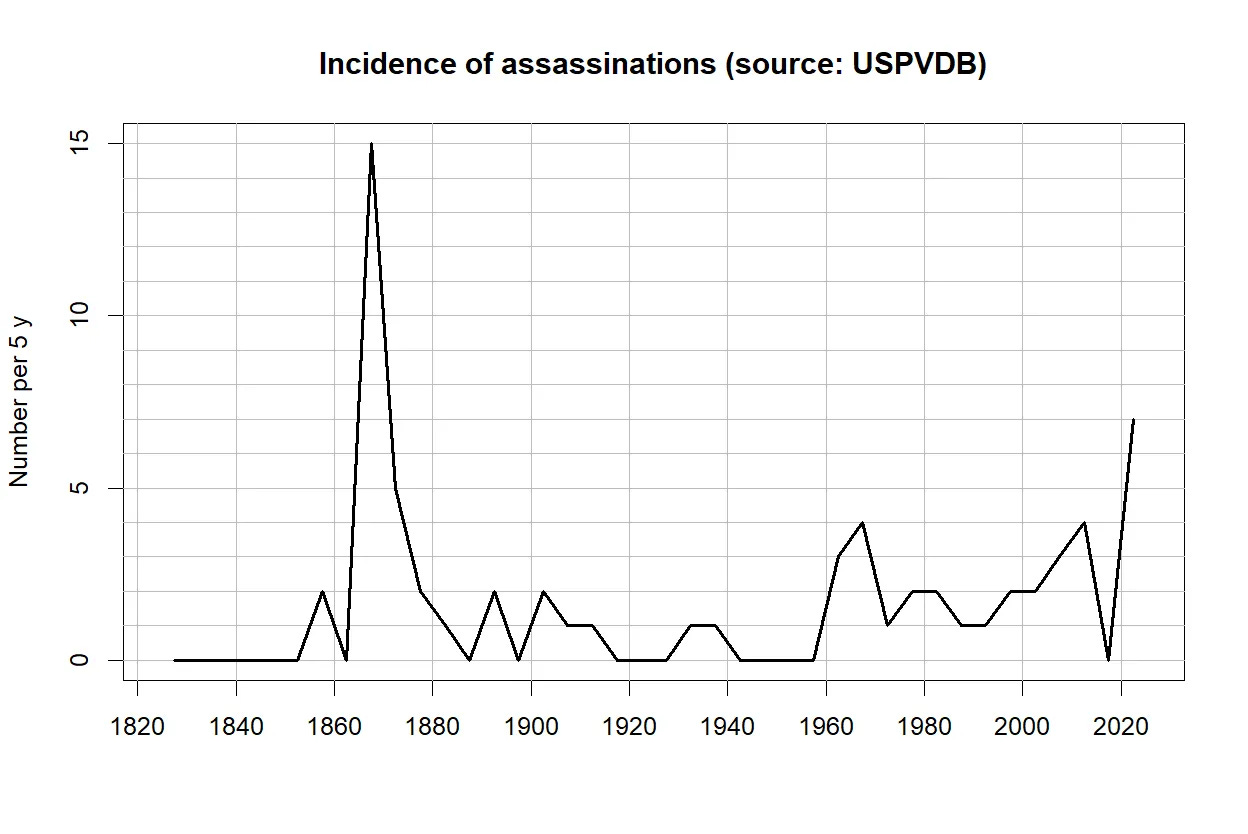
As Turchin argues, whether it is assassinations or “shooting rampages,” both represent manifestations of political instability that he ascribes primarily to two root structural conditions: “popular immiseration and overproduction of credentialed elite aspirants.”
In brief, declining well-being and growing “precarity” of the commoners and overproduced degree-holders, coupled with an explosion in the numbers and wealth of the uber-rich, results in the feeling of profound injustice among the non-elite population. While many of them meekly accept their diminishing prospects, some minority radicalizes and becomes motivated to strike a blow against the unjust system. […] Such people become counter-elites who organize popular discontent against the established elites. But others, often loners without organizational skills, decide to act as individuals, turning into terrorists/assassins.
While only a relative few are ever motivated and inclined to engage in such acts as political assassination or terrorism, there is always a somewhat larger number “that support and cheer them.”
According to one poll, taken in December of 2024, 10% of responders viewed [Luigi] Mangione as a “hero” (Only 10% Consider Man Who Murdered United Healthcare CEO a Hero). This is much smaller than the 53% who viewed him as “villain”, but still, one in ten Americans support and cheer a cold-blooded murderer? Interestingly, support for this assassination was particularly high among the overproduced degree-holders: “Among voters with a postgraduate degree, 15% consider the killer a hero. Only 8% of those with a Bachelors’ degree share that view along with 9% of those without a college degree.”
In the wake of Charlie Kirk’s assassination, Vice President J.D. Vance quoted a YouGov poll on political violence, saying:
One truth we must face is that 24 percent of self-described “very” liberals believe it is acceptable to be happy about the death of a political opponent, while only three percent of self-described very conservatives agree... Another truth is that 26 percent of young liberals believe political violence is sometimes justified, and only 7 percent of young conservatives say the same... The data is clear. People on the left are much likelier to defend and celebrate political violence. This is not a both-sides problem.
Turchin notes that political assassinations and terrorism by themselves are not the means by which established elites are overthrown and replaced by counter-elites. Rather, these are more likely to serve as a “triggering event for a revolution or an onset of civil war.” A “well-organized and committed counter-elite party” is necessary in order to succeed.
Lobaczewski, in common with Turchin, highlights the importance of secular cycles and the social conditions at their tail ends in the origins of political evil. He even got close to an understanding of elite overproduction, though he framed it in terms of socio-occupational adjustment, in which those with the innate ability are blocked from the positions best suited for them—positions which are increasingly occupied by individuals without the talent necessary to perform them. This results in a growing class of aspiring elites and fosters revolutionary sentiments.
Where Lobaczewski differs from Turchin is his psychological framing. For example, he focuses on what he calls the “hysterical” conditions that precede a crisis. And, of course, he stresses the role of psychopathology in the activists who become the leaders of a post-revolutionary totalitarian system.
In the Introduction to Lobaczewski’s book, I argue that the so-called “Left” in American politics is one contemporary example of a “secondary ponerogenic union.” That is, a political group or movement that has adopted ideas originating from doctrinaire and somewhat nihilistic and schizoidal ideologies and has been saturated with individuals with various personality disorders.
As Lobaczewski argues, such groups will experience the defection of many of their members as they become progressively more pathological in their views and actions, and deviate further from their initial values and aims. As these members leave, their positions are filled by those naturally attracted to such things, thus further saturating the membership. We’ve been seeing this process play out over the past several years in the Democratic Party and their supporting groups. High-level examples include individuals like Tulsi Gabbard and Robert Kennedy, Jr. On the grassroots level, it is Democratic voters switching over their party status and voting Republican. And it is people like this:
collects several examples of centrist and apolitical minority TikTokers, as well as a few actual liberals, defecting from the Left over what they see as the inhuman response to Kirk’s assassination on September 10, 2025. Klopp writes:
On X you’ll see the the Right expose Leftist callow- and callous-ness where the 24 hour news-cycle used to cover this outrage. You’d be forgiven for thinking that we are alone with our anger and rage in the war against this dehumanizing enemy. But you’d be wrong. Something else is happened off X (and the other echo-chamber BlueSky). A normie revolt is brewing against the Left among the least likely participants in the political arena.
If you’re like me you probably think that the Left either celebrates murder or merely issues pro forma lip service while latently agreeing with their more extreme co-partisans… and that’s more true than ever. But what we haven’t taken into account - what we NEED to take into account - is an army of centrists or apolitical “normies” who are finally waking up to what we’ve known all along: the Left is the unreasoning side of extremists.
This is both reassuring and concerning. It is reassuring because, as Lobaczewski is at pains to repeat in his book, the real problem is always a fewer number of people than you’d expect. It’s only the propaganda, echo-chambering, and fractured social ties that make us think we’re up against a monolithic and monstrous majority. Instead, it’s always a relatively small minority responsible for the majority of the problems. Unfortunately, that is also why it is concerning, because during times of political crisis, it is always such small groups that do so much damage—whether they’re successful in their larger aims or not.
As more liberals leave behind “the Left,” it will become increasingly clear that they are leaving something they no longer recognize. That is because of what Lobaczewski calls the ponerization process, which steadily deforms the group’s ideology and humanity. The names and words may stay the same, but the group comes to acquire an entirely new character, made that way by opportunistic psychopaths.
After posting an article by a fellow psychiatrist on radicalization in the wake of Kirk’s assassination, Iain McGilchrist received a torrent of critical comments. He responded here, which included the following gems:

The assassination of a young man - a young man, I should add, of whom I knew nothing until he was killed –because his opinions do not conform to your own is now apparently not only justified, but becomes the subject of scornful laughter and rejoicing. This is pure barbarism; barbarism is the downfall of civilisation.
In the UK there is (or was heretofore) a much lower rate of physical violence than in the US. But there has come about a radical shift towards what I think may fairly be called the totalitarian left. … This totalitarianism is far from ‘soft’ in reality. It shouts down and physically assaults those who disagree; it destroys careers and turns people into non-persons; it skews debate in academe, even in the sciences. There is no question that students and their teachers who dissent from the ‘woke’ dogma hide their reasonable opinions out of fear, and this has been repeatedly confirmed by research. I know from conversations with people who lived under totalitarianism in Eastern Europe that the situation in the UK now is worryingly resonant with their experience.
When we are considering the genesis of totalitarian thinking, it is worth remembering that the indescribable crimes which totalitarianism in the 20th century committed almost all took place in leftist regimes … I mention this not to ‘score points’ or ‘point fingers’, but to suggest that we continue to look for totalitarianism coming from the right, whereas it may be – indeed it already is – coming from the left.
Furthermore there is blatant discrimination against those who have no ‘protected characteristics’, especially young white males. The name DEI is deeply ironic, since it acts to exclude rightful candidates, is founded on a philosophy of inequality, and debars diversity of thought, opinion and culture. Unsurprisingly all this builds resentment; and those who help build and sustain it must accept much of the responsibility for the backlash that is coming, and of which, to be absolutely clear, I deplore the prospect. Extreme positions inevitably, in the end, produce extreme reactions. By temperament and by upbringing I have always looked to harmony and peace, and abhor discord and violence. Unfortunately I have seen disharmony and violence deliberately stoked in civil society during the last 20 to 30 years.
As I often say, I think the old terms ‘left’ versus ‘right’ are losing their meaning, and it is more a case of extremists (of either left or right) versus those of a tolerant centre.
Lobaczewski would agree with this perspective. Totalitarianism may most often (or nearly always) emerge on left, but those who use the left to achieve it are better characterized as opportunistic psychopaths.
If there’s one advantage to the uninhibited display of psychopathic glee at the public execution of a man in front of his family, it’s that those doing so felt brazen and powerful enough to do so in public. They have basically offered the public a visible self-diagnosis of their own political pathology.
Scott Adams argues that such people are hypnotized, and points out just how easy this was to achieve through simple repetition by authoritative people in suits. Lobaczewski uses the word “spellbound.” However, it is probably more complex than that.
One of the intentions of such propaganda, when directed by political psychopaths, is to use it as a fishing expedition. They send out the signal in the hopes of targeting a number of people similar to themselves. Those close to such individuals might observe what they characterize as a complete change in personality or character. In Poland in the early 1950s, as Lobaczewski described it, former friends and colleagues became hard-hearted supporters of the new regime, something those friends and colleagues would never have predicted. In that time and place, only 6% of the population were ever affected to that degree—some only temporarily and many permanently.
He made it his goal to find out what, if any, features predisposed these individuals to that response. He found the answer: various forms of psychopathology, most often high-functioning or subclinical, including dangerous personality disorders like psychopathy, the effects of certain types of brain damage, and other cognitive defects or dysfunctions. There was only a limited number of suitable “fish” in the pool, the aforementioned 6%. Unfortunately, this number is probably higher in the U.S. at present.
Lobaczewski describes how humanity has typically dealt with people of these types, from the distant past to the present, as something like “natural eugenic processes.” These include such practices as shaming, ostracizing, banishment, imprisonment, castration, and various forms of capital punishment. Humanity instinctively strives “to eliminate biologically or psychologically defective individuals.” However, while these practices have been more or less successful in the past, he considers them mostly inhumane and inefficient, the latter largely because, while they may achieve temporary victories, they further inspire the next outbreak of piggybacking their own brand of “profound injustice” on the sentiments of the wider immiserated masses. He thought it possible to achieve greater effects with more humane methods.
Despite the fears among some that Kirk’s assassination would provoke a wave of violent reaction on the “Right,” that has so far failed to materialize. The response has been nonviolent, unlike the reaction to George Floyd’s death by overdose.
Here is how Matt Walsh described the current response:
There is a fundamental difference between the cancel culture that the left engages in and the “cancelling” that the right is doing in the wake of Charlie’s assassination and the left’s celebration of it. The difference is that the left will cancel you for saying objectively true, good, and normal things. To the extent that the right cancels you, it’ll be for saying objectively abhorrent, perverse, and sick things. And this distinction matters.
Walsh is describing what pathocrats do: criminalize and otherwise disincentivize expressions of normality. They invert the moral order and punish natural expressions of it.
The idea that society must treat all speech exactly the same as if it’s impossible to distinguish between benign everyday truth and the deranged hallucinatory rantings of bloodthirsty sociopathic hobgoblins is totally ludicrous. […] We cannot have a civilized and decent society unless there are severe social consequences for people who express publicly these kinds of sentiments.
This is the natural response to “biologically or psychologically defective individuals.” And below, he gives an example of what Lobaczewski calls the “moralizing response” to evil:
Now take that nurse I mentioned earlier. Just think about this. Upon seeing that a man with a wife and two young children had been shot in the throat on stage, her first reaction was to cuss out his kids and his mother and gloat about the murder. […] That is a revelation of her character and it is a the character of someone who is barely human at this point. Barely has a soul. You know, it’s the character of someone who is unfit to live among civilized people, of someone who should be shunned and shamed and alienated by society. Not through force of law, not through legislation or legal consequence. Certainly not through violence, but through social rejection.
In the absence of something like a ponerological understanding and program, which would include psychological screening and monitoring of such people, this strikes me as a relatively measured, normal, and even necessary response. Lobaczewski even ascribes the rise in the numbers of such people to the modern interference with those practices mentioned above. We swung too far in the opposite direction, and balance needs to be restored.
While Vance and Walsh are correct that there can be no unity with such people, because the psychological gulf between us is one of kind and not degree, Lobaczewski’s message is that there can be unity among the remainder of normal people: among the majority. Usually such unity is only gained at the price of decades of totalitarian pathocracy. Hopefully that won’t be the price we have to pay this time around.
"Totalitarianism may most often (or nearly always) emerge on left, but those who use the left to achieve it are better characterized as opportunistic psychopaths."
And that seems to be exactly what's happening.
Given that, I completely agree that abhorrent comments should be dealt with as they've always been dealt with: via public shaming and NOT legality which can be used to suppress free speech under the umbrella of hate speech. I'd rather live in a world where I was subjected to hate speech than in one where speech of any kind was banned.
We need to remember the old adage I was taught in grade school (many years ago!): "Sticks and stones may break my bones but words can never hurt me." Hurt feelings must never be grouds for restricting freedom.
Thanks, Harrison, not only for this sharp summary, but for all your work in helping to pull timeless truths back from the precipice and sharing the hard-won knowledge with the rest of us, in an accessible way. 🙏🏼
It’s both fascinating and horrifying to see the “first criterion of ponerogenesis” in action. Glee at an assassination: plainly disordered behaviour, publicly excused and even admired. Whilst it’s encouraging to hear that normies are recoiling at the disgusting behaviour shown in so many videos on X and other places, it’s difficult to know how exactly to deal with so many of the “infected”… What social consequences are most effective??